How to Choose a Responsible Goldendoodle Breeder
Last updated: 2026-03-24
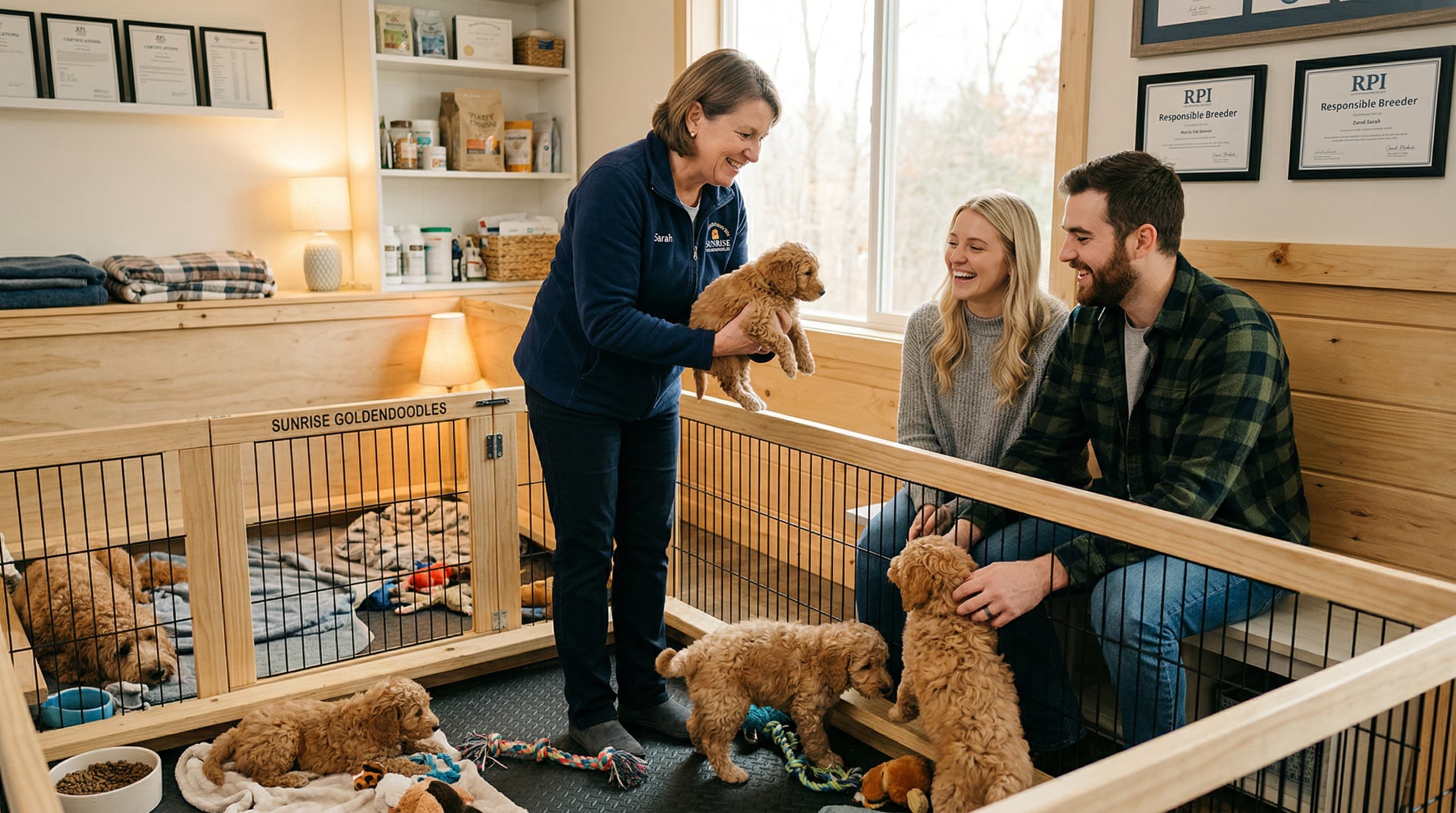
Choosing a Goldendoodle breeder is one of the most important decisions you'll make as a future dog owner. The breeder you select directly determines your puppy's genetic health, temperament, and early socialization — factors that affect your dog for its entire 10-15 year lifespan. Unfortunately, the Goldendoodle's popularity has attracted many irresponsible breeders and puppy mills looking to capitalize on demand. This guide will teach you exactly what to look for, what questions to ask, and what red flags should send you running.
Why Breeder Selection Matters So Much
The difference between a well-bred Goldendoodle and a poorly bred one isn't just cosmetic — it's medical. A puppy from untested parents can develop devastating health conditions like hip dysplasia, heart disease, or progressive blindness. These conditions cause suffering for the dog and can cost thousands of dollars in veterinary bills. A puppy from a mill or backyard breeder is also more likely to have behavioral problems stemming from poor socialization during the critical first 8 weeks of life.
The price difference between a well-bred and poorly bred Goldendoodle is typically $1,000-$2,000 upfront. But the lifetime cost difference — in veterinary bills, behavioral training, and heartbreak — can be tens of thousands of dollars. Choosing the right breeder is the single best investment you can make in your future dog's quality of life.
Think of it this way: you're not buying a product — you're choosing a genetic foundation and an early life experience for a living being that will be part of your family for over a decade.
Green Flags: Signs of a Responsible Breeder
1. Comprehensive Health Testing
This is the number one indicator of a responsible breeder. At minimum, both parent dogs should have:
- OFA Hip Evaluation — rated Good or Excellent (not just "vet checked")
- OFA Elbow Evaluation — rated Normal
- OFA Cardiac Evaluation — performed by a board-certified cardiologist
- Annual Eye Exam (CAER) — performed by a veterinary ophthalmologist
- Comprehensive Genetic Panel — testing for PRA, vWD, DM, Neonatal Encephalopathy, Ichthyosis, and other breed-relevant conditions
All results should be verifiable on the OFA public database (ofa.org). If a breeder can't provide OFA numbers you can look up yourself, that's a disqualifying red flag. "Vet checked" is not health testing — a vet check is a basic physical exam that cannot detect genetic conditions or structural abnormalities visible only on X-ray.
2. Structured Puppy Socialization Program
The first 8 weeks of a puppy's life are critically important for behavioral development. Responsible breeders implement structured socialization programs — the most well-known being Puppy Culture or ENS (Early Neurological Stimulation) protocols.
These programs expose puppies to various sounds, surfaces, textures, handling, and mild stressors during developmental windows when their brains are most receptive. Puppies raised with these protocols tend to be more confident, resilient, and adaptable as adults. They handle new experiences — veterinary visits, grooming, car rides, meeting strangers — with significantly less stress.
Ask breeders specifically what socialization protocol they follow and how puppies are exposed to household sounds, different surfaces, gentle handling, and novel experiences before they go home.
3. Transparency and Open Communication
A responsible breeder welcomes your questions — all of them. They're proud of their program and happy to explain their health testing, breeding decisions, socialization protocols, and the reasoning behind everything they do. They will:
- Share health testing results proactively (often on their website)
- Invite you to visit their facility (or provide detailed video tours)
- Introduce you to the parent dogs
- Explain their breeding goals and why they chose specific pairings
- Be honest about potential challenges of the breed (grooming requirements, exercise needs, etc.)
- Provide references from previous puppy families
4. Health Guarantee and Return Policy
Reputable breeders stand behind their puppies with a written health guarantee — typically covering genetic health conditions for 2 years. They will also have a lifetime take-back policy: if you can never keep the dog for any reason, at any age, the breeder will take them back. This prevents their puppies from ending up in shelters.
Read the contract carefully before signing. A good breeder's contract protects both you and the puppy. Be wary of contracts with excessive restrictions or no health guarantee at all.
5. Limited Number of Breeds and Litters
Responsible breeders typically focus on one or two breeds and produce a limited number of litters per year. This allows them to give each litter the time, attention, and resources needed for proper socialization and care. A breeder who produces dozens of litters per year across multiple breeds simply cannot provide the individual attention that creates well-adjusted puppies.
Red Flags: Warning Signs to Watch For
1. No Health Testing (or Only "Vet Checked")
If a breeder can't provide OFA numbers and genetic panel results for both parents, walk away. Period. "My vet says they're healthy" is not equivalent to OFA hip X-rays, cardiac evaluations by a cardiologist, and comprehensive DNA testing. This is the single biggest red flag in the breeding world.
2. Always Available Puppies
Good breeders have waitlists. If a breeder always has puppies available for immediate purchase, they're likely producing too many litters. Responsible breeding programs plan litters carefully, and demand for well-bred Goldendoodles far exceeds supply. Waiting 3-12 months for the right puppy is normal and expected.
3. Won't Let You Visit or Meet Parents
If a breeder refuses to let you visit their facility or meet at least the mother dog, something is wrong. They may be hiding the conditions their dogs live in. Some breeders in rural areas may offer video tours instead of in-person visits, which is acceptable — but they should still be willing to show you where and how their dogs live.
4. Unusually Low Prices
Health testing, quality nutrition, veterinary care, early socialization, and proper breeding management are expensive. A well-bred Goldendoodle typically costs $2,500-$5,000 depending on size and location. If you find Goldendoodle puppies significantly below this range — say $800-$1,500 — there's a reason. The breeder is cutting corners somewhere, and those corners usually involve health testing, veterinary care, or living conditions.
That said, a high price doesn't guarantee quality either. Some puppy mills charge premium prices while providing none of the care that a responsible breeder delivers. Always verify health testing regardless of price. For a detailed cost breakdown, see our Goldendoodle cost guide.
5. Pressure to Buy Quickly
"This is the last puppy available!" "Someone else is interested, so you need to decide today!" "Put a deposit down now before you lose your spot!" These high-pressure sales tactics are hallmarks of irresponsible breeders and scammers. A responsible breeder wants you to make a thoughtful decision. They'd rather you take time to be sure than pressure you into a commitment you're not ready for.
6. Ships Puppies Sight Unseen
While some reputable breeders do arrange flight nannies for out-of-state families, a breeder who ships puppies to anyone with a credit card — without an application process, interview, or vetting of the buyer — is a red flag. Responsible breeders care deeply about where their puppies end up and screen potential families carefully.
Essential Questions to Ask a Breeder
When you contact a potential breeder, come prepared with these questions:
- "What health testing do you perform on parent dogs?" — Look for OFA hips, elbows, cardiac, eyes, and genetic panel. Ask for OFA numbers.
- "Can I see the health testing results?" — They should be readily available, ideally on the breeder's website.
- "What socialization program do you use?" — Puppy Culture, ENS, or a structured equivalent.
- "How many litters do you produce per year?" — More than 4-5 per year (without co-breeders/guardian homes) is a yellow flag.
- "What does your health guarantee cover?" — Should cover genetic conditions for at least 2 years.
- "Do you have a take-back policy?" — Lifetime take-back is the gold standard.
- "Can I meet the parent dogs?" — Yes should be the default answer.
- "Where do the puppies live?" — In the home, not in kennel runs or outdoor pens.
- "What food do you feed the puppies?" — Should be a high-quality puppy food.
- "What comes with the puppy?" — Expect: vet records, deworming history, first vaccinations, microchip, health guarantee, and a take-home kit.
Where to Find Responsible Breeders
Start your search in the right places:
- Goldendoodle Association of North America (GANA): GANA-registered breeders must meet specific health testing requirements
- OFA Database: Search for breeders in your area with documented health testing
- Veterinary referrals: Ask your vet who they recommend
- Breed-specific communities: Facebook groups and forums dedicated to Goldendoodles can provide referrals
- Dog shows and events: Meet breeders in person at dog-related events
The Application Process: What to Expect
Don't be surprised or offended when a responsible breeder asks you to fill out an application. Good breeders vet their buyers as carefully as buyers should vet breeders. Expect questions about:
- Your living situation (house, apartment, yard access)
- Who lives in your household (including other pets)
- Your work schedule and how much time the dog will be alone
- Your experience with dogs
- Your grooming plan (how you'll maintain the coat)
- Your veterinary reference
The Bottom Line
Choosing a responsible Goldendoodle breeder requires patience, research, and a willingness to wait for the right puppy. Don't let excitement override due diligence. The 3-12 months you spend on a waitlist will pay dividends for the next 10-15 years of your dog's life.
Remember the non-negotiables: comprehensive health testing (OFA + genetic panels), structured socialization, transparency, and a written health guarantee. If a breeder checks all these boxes, you're on the right track.
Looking for a breeder who meets every standard on this list? Doodle Bliss is a family breeding program in Gilbert, Arizona, where every parent is Embark-tested for 190+ genetic conditions, OFA hip and cardiac evaluated, and every litter is raised using Puppy Culture socialization protocols. Learn more about our program and available puppies →
🛒 Our Top Picks for New Puppy Families
- Embark Dog DNA Test — Verify your puppy's breed makeup and check for 250+ health conditions
- Puppy Culture Film & Workbook — Learn the socialization protocol top breeders use
- Snuggle Puppy Behavioral Aid Toy — Eases the transition from breeder to your home